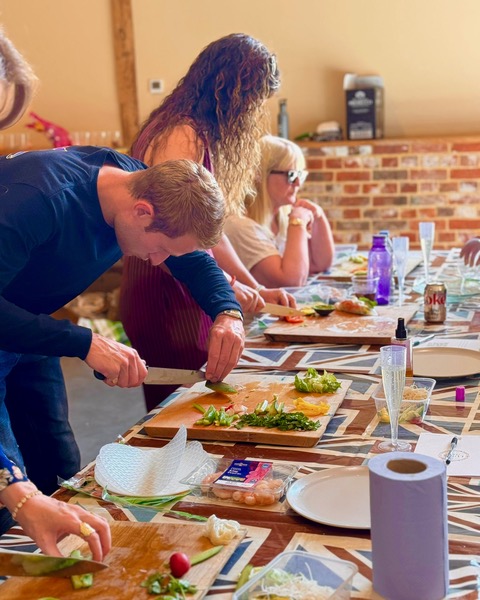
When people search for culinary wellbeing workshops, they are rarely looking for just a cooking class. They want something that supports wellbeing, builds connection, and feels welcoming to everyone in the room. Here is what research suggests, where it is still thin, and how we approach the work.
Research on cooking and wellbeing is promising but early. Most studies are small, and many show associations rather than proof. We share it honestly.
What the research shows
Farmer, Touchton-Leonard and Ross (2018) reviewed 11 studies of cooking interventions in adults. Hospital and community programmes were linked with better socialisation, self-esteem, quality of life and mood. The authors also judged the research to be generally weak in quality, with non-randomised designs and small samples, and described the evidence as preliminary and limited.
Newer studies point the same way, with the same caveats. In a 2024 pilot, Mörkl et al. offered five cooking workshops, led by a chef and a nutritional therapist, to 39 psychiatric inpatients with depression or eating disorders. Questionnaires completed before and afterwards showed improvements in mood, sadness, hopelessness and tiredness across the group, and 90% said they would recommend the workshops. Patients with depression improved on nearly all mood measures, while those with eating disorders improved on sadness only. It was a small pilot.
In Australia, Rees et al. (2022) followed 657 healthy adults on a seven-week community cooking programme, compared with a waiting-list group. Cooking confidence rose, and self-reported mental and general health improved, although the mental health effect was small. Food purchasing and eating habits did not change.
Connection and the workplace
A 2025 scoping review of 30 culinary workshop studies (da Fonseca et al.) looked mainly at eating habits and health. Quality of life improved significantly in three of the seven studies that measured it, and other studies reported qualitative signs of better wellbeing and social engagement.
Daker et al. (2024) studied workplace teaching kitchen classes. Even a single class produced a measurable gain in food skills and motivation, and the programme engaged employees with low food skills. Some staff felt intimidated at the thought of cooking with colleagues, which held them back from signing up. The study measured food literacy rather than mental health, but it is a useful reminder that how a session is designed and hosted matters.
A 2026 perspective paper (Wong et al.) describes culinary nutrition education as "a strengths-based, theory- and evidence-informed approach to mental health promotion and prevention". It also notes that research quality is variable.
What we take from it
The research cannot yet tell us exactly which parts of a session do the work, so what follows is our own reading rather than a research finding. Cooking gives people a shared task, something sensory to focus on, and a result they can taste. Sitting down to eat together leaves room for conversation. Who is in the room, and how they feel about cooking, seems to matter as much as the recipe.
That is why we think about a culinary wellbeing workshop differently from other formats. A cooking class teaches technique. A team-building day uses cooking to bring a group together. A culinary wellbeing workshop starts from another question: how do people feel, and connect, while they cook? We do not claim one format is better. They simply have different aims.
What welcome looks like
Inclusion is a practical matter, not a slogan. In our experience it means:
- Every skill level: people who have never cooked feel as welcome as those who cook daily
- Every table: dietary needs and cultural food traditions are respected, not flattened into one cuisine
- Every relationship with food: no performance, no pressure, and room to opt out of any step
- Every body: the space and tasks are adapted for different abilities and mobility
What to look for in a provider
If you are commissioning culinary wellbeing workshops for a workplace, community group or organisation, these questions are worth asking:
- Are the aims about wellbeing and connection, not just what will be cooked?
- How do they help people feel at ease, including anyone anxious about cooking or food?
- Will the session be tailored to your group?
- Can they explain the research behind their approach, and its limits?
- How do they include different dietary needs, cultures and abilities?
The Luma House approach
Our culinary experiences are designed around unhurried pace, hands-on participation, and care for the people in the room. Our workshops are designed for wellbeing and connection. They are not a medical or therapeutic treatment, and they do not replace professional care.
An honest conclusion
Cooking together is a promising, very human way to support wellbeing, and the evidence is encouraging. It is also still growing, and we would rather say so than promise more than the research can show.