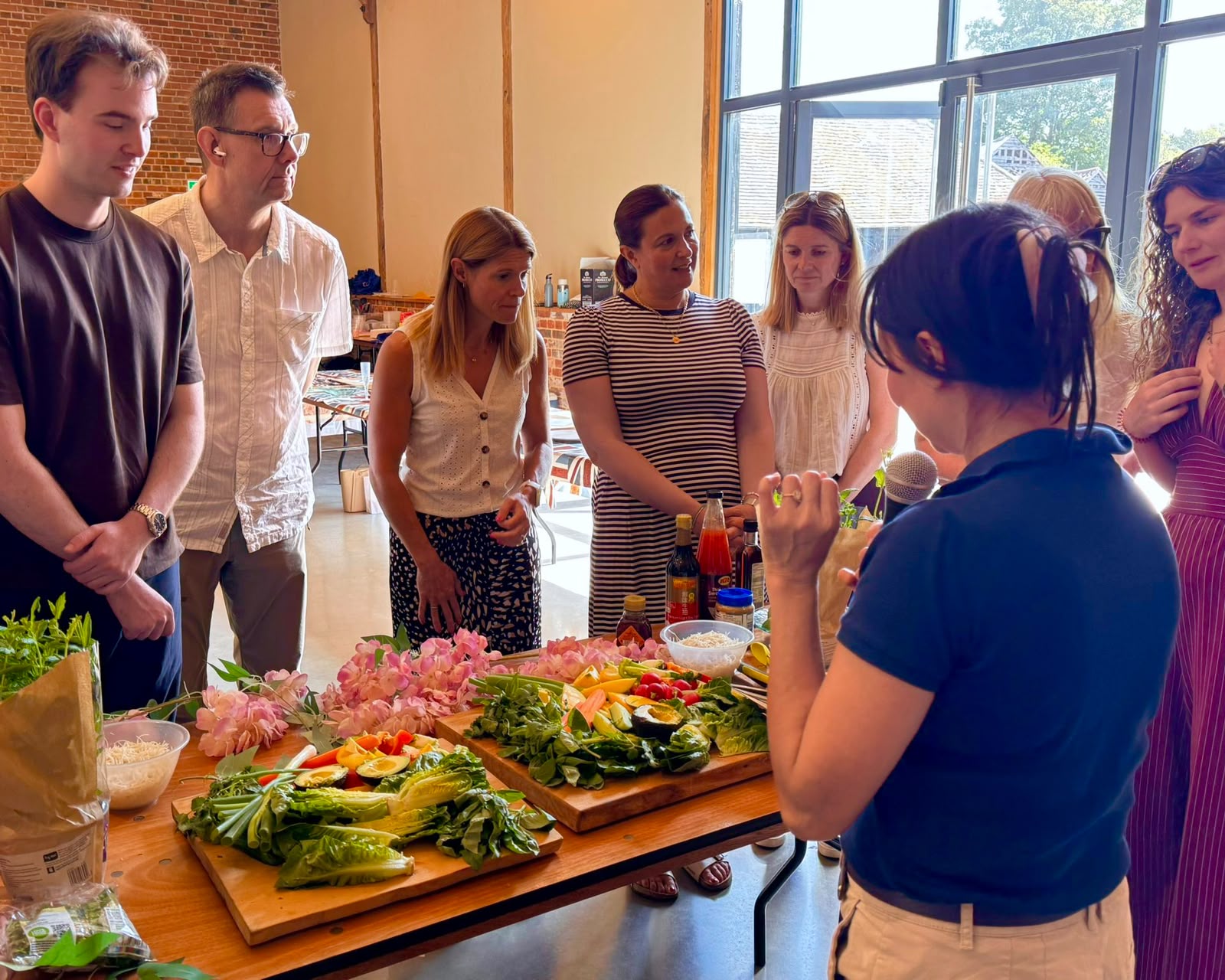
Think about the last time you felt genuinely at ease with a group of people. Chances are, there was food involved. Not a grand occasion, just something shared: a dish passed around the table, the scent of something cooking, the unhurried rituals of preparing and eating together.
Food softens a gathering, gives hands something to do, and makes conversation easier. That is what we care about at Luma House, and this article looks at what research can, and cannot, tell us about why.
The 2025 World Happiness Report found that sharing meals is strongly linked with wellbeing, on a par with income and unemployment. It is an association, and the authors are clear that cause and effect are not yet settled (De Neve et al., 2025).
Why food changes the feeling of a gathering
Almost every culture marks its important moments with food: births, marriages, losses, reunions. Eating together is a small act of trust, and it gives people a reason to be present without having to perform. Nobody needs to be impressive when there is something delicious to focus on.
Researchers have begun to measure this. Oxford psychologist Robin Dunbar analysed a survey of 2,000 UK adults and found that people who eat socially more often tend to feel happier and more satisfied with life, trust others more, feel more engaged with their community, and have more friends they can rely on (Dunbar, 2017).
A note of caution. Dunbar's analysis suggests the direction runs from eating together to bonding, but this was a survey, not an experiment, and he says experiments are needed to confirm it. Friendship and shared meals probably feed each other. Meals after which people felt closer also tended to involve more people, more laughter and more reminiscing, so food may matter partly because it gives us the chance for laughter and stories.
A wider picture
The World Happiness Report drew on Gallup data from 142 countries and territories. People who shared more meals reported higher life satisfaction and more positive emotions, and fewer negative ones. The pattern pointed the same way across ages, genders, cultures and regions, though it was stronger for younger people and varied in size between regions. Those who shared more meals were also less likely to feel lonely and more likely to have someone to count on (De Neve et al., 2025).
Across countries, one extra shared meal a week went with a life satisfaction score about 0.2 points higher on a ten-point scale, roughly five places in the global rankings. That is a comparison between countries, not a promise about any one person.
How cooking together adds something more
Cooking together changes the dynamic. There is a task, so conversation does not have to carry all the weight. There is something to learn, a shared result, and a meal that means a little more because everyone had a hand in it.
The evidence here is encouraging but early. A systematic review of 11 studies found that cooking interventions in hospital and community settings were linked with better socialisation, self-esteem, quality of life and mood. The authors rated most of the research as weak in quality and called the evidence preliminary and limited. In one included study, some participants were still preparing meals as a household team six months later (Farmer, Touchton-Leonard and Ross, 2018). Separately, a survey of about 8,500 New Zealand secondary students found that greater cooking ability was associated with stronger family connections, better mental wellbeing and fewer depressive symptoms (Utter et al., 2016). These are associations, not proof.
A meal, and a meaningful culinary experience
Not every shared meal brings people closer. The research does not give a recipe for avoiding that, so what follows is our own philosophy at Luma House rather than a research finding.
We think the difference is intention. A meal meets a need. A culinary experience can be shaped so that connection has room to happen:
- Pace: unhurried, with time to arrive
- Participation: something to do with your hands
- Sensory richness: aromas, textures and flavours that bring you into the moment
- Gentle structure: enough shape to feel easy, enough space to stay spontaneous
- Care: the sense that someone has thought about you
How Luma House designs experiences
Every experience begins with one question: what does this group need in order to feel at ease with one another? The answer shapes the ingredients, the pace, how the space is prepared, and the moments left open.
Cooking is central to our practice. It is aromatic, tactile and layered, and it invites people to taste, smell and share. Sessions are led with culinary knowledge and care for the people in the room.
Our experiences can be tailored for professionals, corporate team building or friends and family. They are designed for connection and enjoyment and are not a medical or therapeutic treatment.
Gather around something that matters
Food does not guarantee connection, but the research suggests that sharing meals goes hand in hand with feeling better, and that cooking together is a promising place to begin. It does not need a special occasion. It needs a little intention.