When most people think about cooking, they think about the end result. A meal on the table. Something to eat. But there is a whole other layer to what happens in the kitchen that we rarely stop to name, and it has very little to do with the food itself.
Wellbeing through cooking is the idea that the act of preparing food, not just eating it, can be genuinely good for us. It can help us slow down, become more present, process our emotions, and feel more connected to ourselves and the people around us. It is not a new concept, but in a world that moves faster than most of us can keep up with, it feels more relevant than ever.
At Luma House, this is the idea at the heart of everything we do. We believe the kitchen can be a place of genuine restoration, not just production.
What Wellbeing Through Cooking Actually Means
Wellbeing through cooking is not about eating perfectly or following a special diet. It is not about being a skilled cook or producing something Instagram-worthy. It is about what the process itself offers you.
When we talk about wellbeing in this context, we mean something quite broad:
- Emotional regulation — the way a repetitive physical task can calm a busy or anxious mind.
- Sensory engagement — the way smell, texture, colour, and sound pull you into the present moment.
- Creative expression — the satisfaction of making something from nothing, of improvising, of putting your own stamp on a dish.
- Social nourishment — the warmth that comes from cooking for someone, or alongside someone.
Research supports what many of us intuitively know. A study in the Journal of Positive Psychology1 found that people who engaged in everyday creative activities experienced greater flourishing and more positive emotions the following day. Creative cooking fits naturally within this idea, suggesting that the kitchen can be far more than a place to prepare food — it can also be a place where wellbeing grows.
The key shift is this: when cooking becomes intentional rather than obligatory, it stops being a chore and starts being a practice.
Why Cooking Feels Grounding
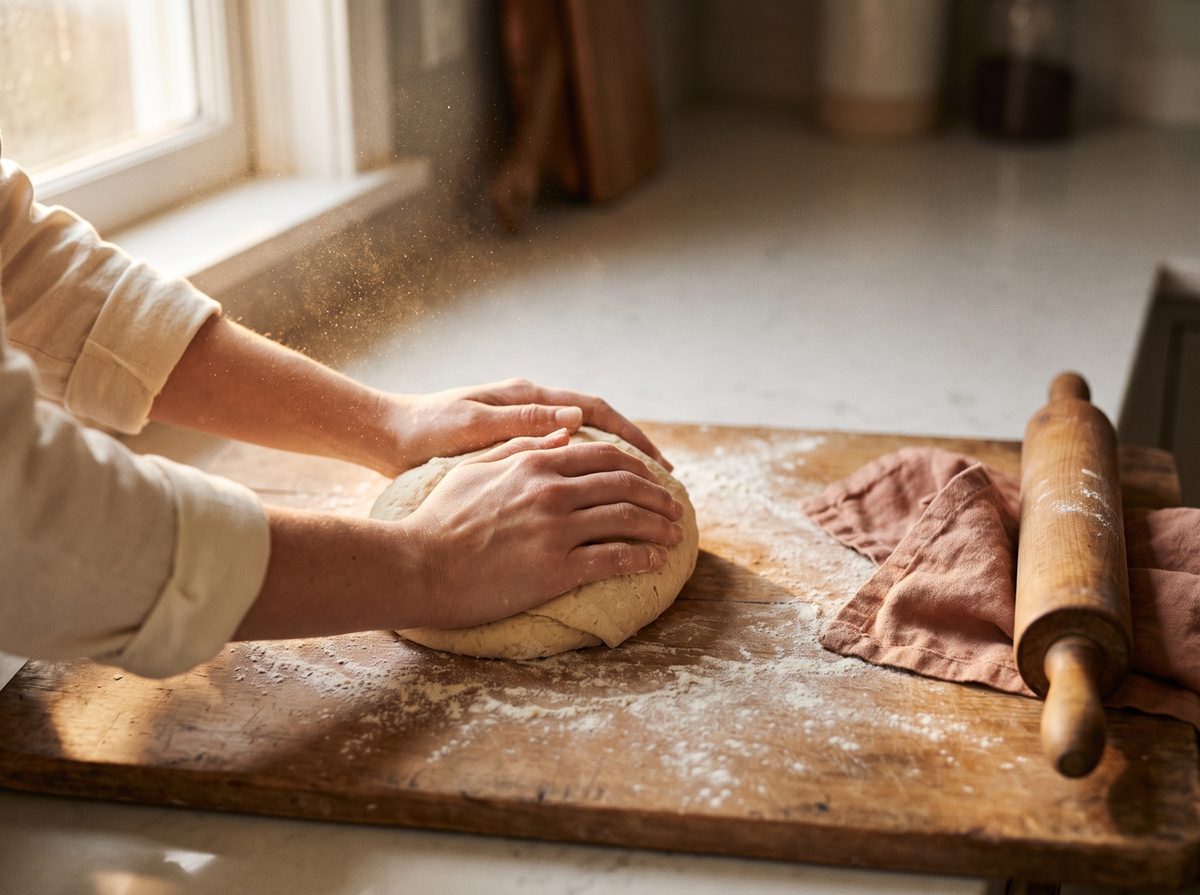
There is a reason so many people turn to the kitchen when life feels chaotic. Cooking is one of the few activities that genuinely demands your full attention — not because it is complicated, but because it is physical and sensory in a way that screens and meetings simply are not.
When you are chopping vegetables, you are not scrolling. When you are listening for the moment oil hits the right temperature, you are not replaying a difficult conversation in your head. The kitchen pulls you out of abstract thought and into the body.
This is what psychologists sometimes call a flow state2 — a state of complete immersion and focused attention in a meaningful activity, where self-consciousness fades and time seems to move differently.
Cooking is far more than preparing a meal. It's one of the most complete neurological experiences we can easily give ourselves.
Every chop, stir, and sprinkle invites the brain into a remarkable sensory conversation. The fragrance of herbs reaches the olfactory system before we've even taken a bite. Colours and movement are interpreted by the visual cortex. The crackle of garlic in olive oil primes the brain to expect flavour before the food reaches the tongue. As our fingertips knead dough, tear herbs, or test the ripeness of a tomato, thousands of sensory receptors send a constant stream of information to the somatosensory cortex, allowing us to feel texture, pressure, temperature, and shape with extraordinary precision.
Even our vestibular system — the part of the inner ear responsible for balance and spatial awareness — is quietly at work as we reach, turn, stir, bend, and move around the kitchen. Cooking isn't a passive task; it's whole-body engagement.
This rich sensory orchestra is why cooking has such extraordinary potential. It gently draws attention away from yesterday's regrets and tomorrow's worries, anchoring us in what is happening right now. In neuroscience, the more senses we engage, the richer the brain's experience becomes. Cooking asks almost every major sensory system to work together.
But there is something even more beautiful. When we cook for others, our brains don't simply process ingredients — they anticipate connection. Through the principles of neurogastronomy, we know flavour is created not only by taste, but by memory, expectation, emotion, sound, sight, and the people we share the meal with. Mirror neurons help us experience the joy of watching someone else savour a dish. A smile across the table can be just as nourishing as the food itself.
As an occupational therapist, I don't simply see cooking as preparing dinner. I see it as a meaningful occupation that supports cognition, movement, confidence, identity, and belonging. Every recipe becomes an opportunity to problem-solve, learn, create, and connect. Every meal becomes an act of participation in life.
Perhaps that's why the kitchen has always been one of the most powerful wellbeing spaces in any home. Not because of the food alone — but because, when we cook, we awaken the senses, stimulate the brain, strengthen connection, and quietly remind ourselves what it feels like to be fully alive.
Rhythm, Repetition, and the Power of Sensory Attention
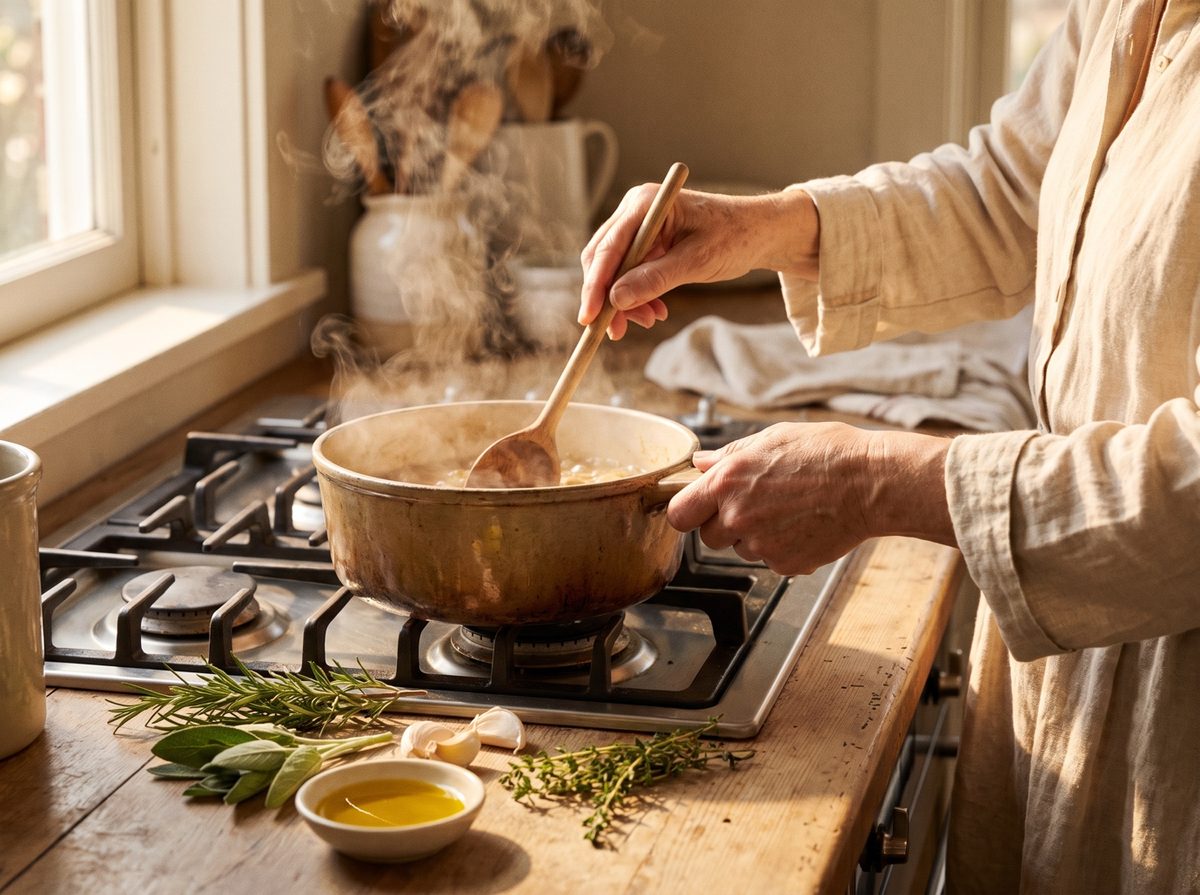
Some of the most calming moments in the kitchen are the repetitive ones. Stirring a risotto. Kneading dough. Peeling garlic. Rolling dumplings. These tasks do not require creative thought; they require patience and presence, and that combination is quietly powerful.
Repetitive physical movement has long been recognised to regulate the nervous system. It is part of why activities like knitting, gardening, and walking have such devoted followings among people managing stress and anxiety. Cooking offers the same thing, with the added bonus that you end up with dinner.
Slowing Down Through the Senses
Sensory attention is the practice of noticing what is actually happening around you, through your senses, rather than through your thoughts. In the kitchen, this happens naturally if you let it:
- The smell of garlic softening in oil.
- The sound of water coming to the boil.
- The weight of a knife in your hand.
- The colour changes as vegetables begin to caramelise.
- The texture of pastry as it comes together under your palms.
Each of these is a small invitation back into the present moment. None of them require a mindfulness app or a meditation cushion. They just require you to notice.
This is why we think of cooking as an accessible wellbeing practice. You do not need to be experienced or particularly skilled. You just need to be willing to pay attention.
Creativity in the Kitchen as a Wellbeing Practice
There is a particular kind of satisfaction that comes from making something. Not buying it, not ordering it, not watching someone else make it. Actually making it yourself.
Creativity does not require talent. In the kitchen, it can be as simple as deciding to add a squeeze of lemon where the recipe did not ask for one, or swapping an ingredient because you felt like it. These small acts of improvisation matter because they remind us that we have instincts worth trusting.
Why Creative Cooking Feels Good
Every time we knead dough, balance flavours, or simply cook with curiosity, we're doing far more than making something beautiful. We're engaging brain networks involved in reward, emotion, and motivation while expressing something uniquely human — the desire to create, connect, and care for one another.
In 2021, the National Library of Medicine4 published research showing that cooking can support psychosocial wellbeing, contributing to social connection, self-esteem, quality of life, and positive mood. It also offers something increasingly rare in modern life: a space to create with our hands, express ourselves, and experience genuine joy.
Cooking sits at an interesting intersection here. It is creative, but it also has structure. There are techniques to learn, flavours that work together, timing that matters. That balance — freedom within a framework — is exactly the kind of creative environment that tends to feel most nourishing rather than overwhelming.
The kitchen is a low-stakes creative space. If a dish does not work out, you try again tomorrow. There is no audience, no performance pressure, no permanent record. Just you, your ingredients, and the willingness to experiment. For people who do not identify as "creative", cooking can be a genuinely surprising entry point into that part of themselves.
Why Shared Food Creates Connection
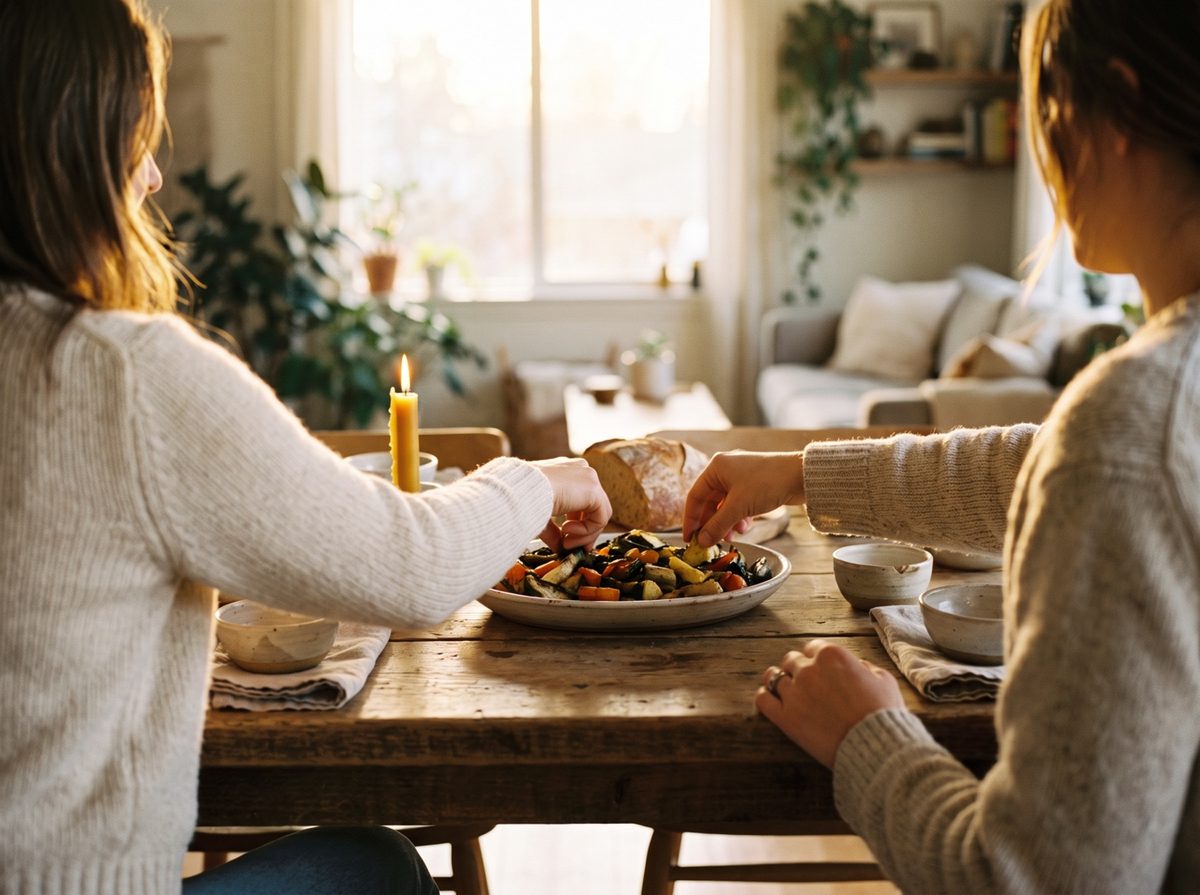
Humans have been cooking together and eating together for as long as we have existed. It is not incidental. Sharing food is one of our oldest and most reliable ways of building trust, expressing care, and feeling like we belong somewhere.
There is something about preparing food alongside someone else that strips away a lot of the usual social awkwardness. You have a task to focus on. You have something to talk about. You are working towards the same goal. The conversation flows more easily because the activity gives it somewhere to go.
And then there is the act of eating together. Studies from Oxford University3 have found that people who eat socially more often feel happier, are more satisfied with life, are more trusting of others, and are more engaged with their local communities. Shared meals may therefore function as a simple, everyday support for social bonding and wellbeing.
This is why food-led experiences work so well as a vehicle for connection. When people cook and eat together, something shifts. Barriers come down. People laugh more. They share more. The food becomes the backdrop for something much more meaningful.
Cooking for someone is also an act of care. It says: "I thought about what you might enjoy. I put time into this. You are worth the effort." That message lands, even when it is never spoken aloud.
How Luma House Brings This to Life
At Luma House, we design experiences around exactly these ideas. Our food-led wellbeing workshops are built on the belief that cooking, when approached with intention and a little curiosity, can be a genuinely restorative practice.
We are not a cookery school in the traditional sense. We are not trying to turn you into a professional chef or teach you to replicate restaurant dishes at home. What we are interested in is what happens to people when they slow down, get their hands into something, and cook alongside others in a space that feels warm and unhurried.
What Our Experiences Offer
Our sessions draw on the principles we have explored in this article:
- Sensory engagement — we work with ingredients, techniques, and flavours that invite you to pay attention and be present.
- Rhythm and repetition — the structure of our workshops gives you time to settle into the process rather than rush through it.
- Creative exploration — we encourage people to trust their instincts, ask questions, and make the dish their own.
- Shared nourishment — every session ends with eating together, because that is where so much of the value lives.
Our approach is informed by both culinary expertise and a genuine interest in wellbeing. We think about why certain practices feel the way they do, not just how to execute them.
If you have ever felt the particular calm that comes from an hour spent cooking something you care about, you already understand what we are trying to create — just in a more intentional, guided, and shared form.